


GATE PULSAR D HPA Engine — Dual Solenoid Closed Bolt, with TITAN II / ASTER II Bluetooth
GATE PULSAR D HPA Engine — Dual Solenoid Closed Bolt, with TITAN II / ASTER II Bluetooth
In stock
Notify Me About This Product
Couldn't load pickup availability
DETAILS
DETAILS


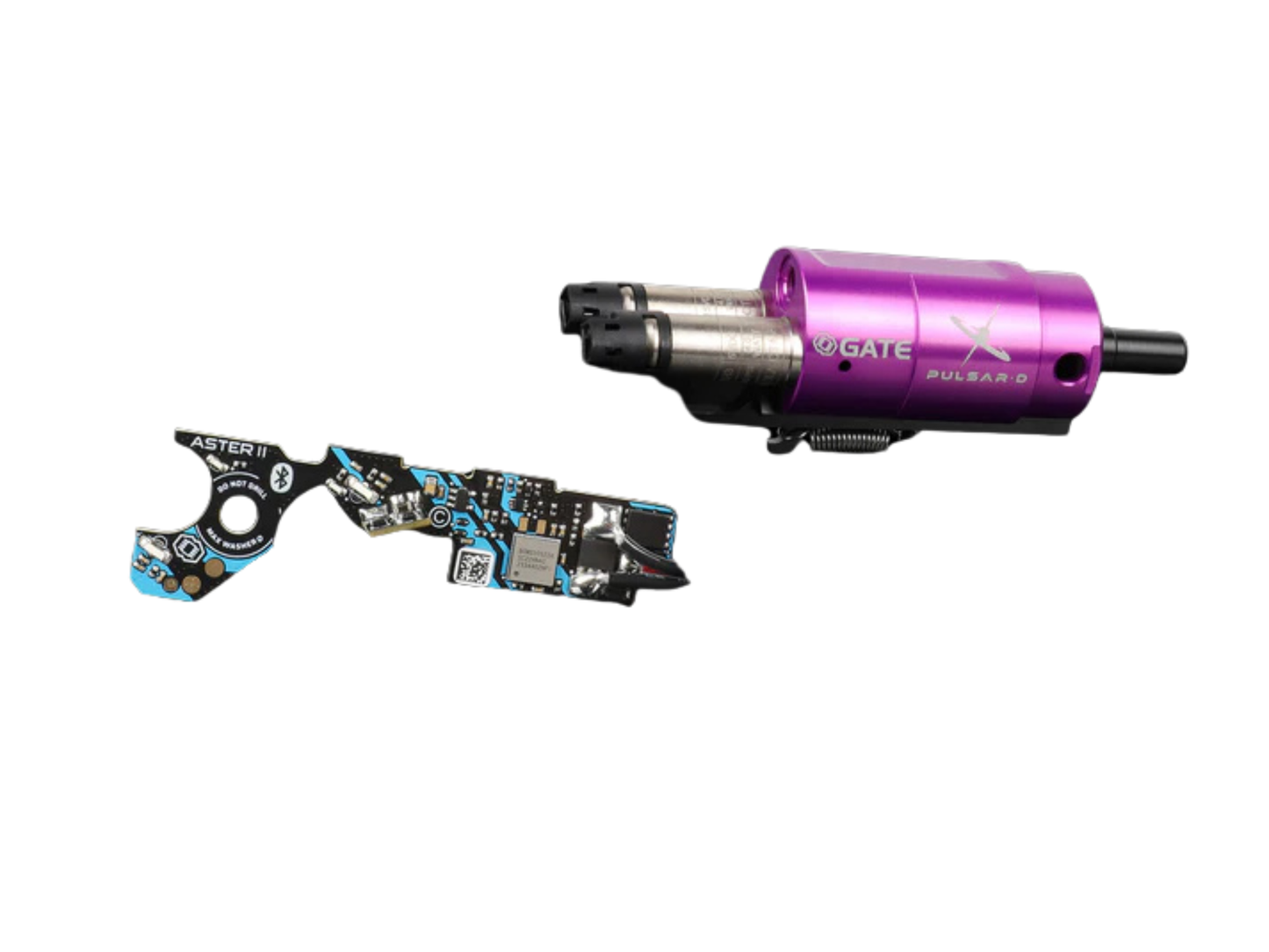
- description
Every open-bolt HPA engine shares the same weakness: it depends on the gun around it. If the gearbox is not axially aligned, the nozzle wanders, the hop seals inconsistently, and you chase FPS spread you cannot fix with pressure. The PULSAR D solves that with a second solenoid and a closed-bolt cycle, driving the nozzle positively in both directions instead of relying on a spring and the build quality around it.
The result is an engine that GATE describe as far less sensitive to replica and assembly quality — zero nozzle wobble, no mid-cap syndrome, and a stable trajectory in full auto rather than just in semi. It holds FPS on auto right up to its 40 RPS ceiling with no drop relative to semi, which is not something most engines can claim.
It is also the more efficient of the two: roughly 0.7 PSI per shot from a 48ci bottle at 90 PSI, against 1 PSI for the PULSAR S. Velocity spans 250 to 650 FPS, so the same engine covers a CQB build and a DMR. Automatic cycle synchronisation handles the calibration that used to mean firing thousands of rounds to find a stable setting.
A multifunctional port lets you add a bolt-catch button, a magazine sensor, a tracer in the hop-up chamber or an electric magazine feed. Everything is configured live through the GCS app over Bluetooth 5.2, including binary trigger, burst, ROF and 50-level optical trigger sensitivity.
Specifications
| Specification | Detail |
|---|---|
| Engine type | Dual solenoid HPA — closed bolt (open bolt mode also supported) |
| Operating pressure | 60–140 PSI (high pressure only) |
| Adjustable ROF | 1–40 RPS — no FPS drop on auto versus semi |
| Velocity | 250–650 FPS (setup dependent) |
| Gas consumption | ~0.7 PSI per shot (90 PSI, 48ci / 0.8L 300 bar bottle) |
| FCU | TITAN II or ASTER II Bluetooth — optical trigger, GCS app |
| Trigger sensitivity | 50 levels in the first 1mm of travel |
| Fire modes | Semi, binary, burst, full-auto — all app configurable |
| Calibration | Automatic cycle synchronisation |
| Dimensions | 102 × 25.4 × 38.5mm with cycle sync (100 × 25.4 × 32mm without) |
| Weight | 90g — smallest dual-solenoid closed-bolt HPA engine |
| Solenoid voltage | 5–8.4V — do not exceed |
| Nozzles | Compatible with AEG nozzles |
| Expansion | Multifunctional port — bolt catch, magazine sensor, hop-up tracer, electric magazine |
| Gearbox | V2 (rear/front wired) or V3 (kit with tappet plate) |
| Connectivity | Bluetooth 5.2, GCS app (iOS, Android, macOS, Windows, Wear OS, watchOS) |
| Operating temperature | -15°C to +50°C |
| Manufacturer | GATE Enterprise, Poland |
Good to know before you buy
Pick the variant to match your gearbox and wiring: rear wired for most V2 builds, front wired where the battery lives in the stock, or the V3 kit which includes the dedicated tappet plate for AK-pattern and other V3 platforms. The D costs more than the PULSAR S and tops out at 40 RPS rather than 100 — you are paying for consistency and forgiveness, not speed. HPA engine fitting is skilled work; we install and configure these through our HPA tech service.
Frequently asked questions
Why choose the D over the cheaper PULSAR S?
Because the D does not depend on your gearbox being perfectly aligned. Its closed-bolt dual-solenoid design eliminates nozzle wobble and mid-cap syndrome, holds FPS in full auto, and uses less air per shot. The S is faster and cheaper; the D is more accurate and far more forgiving of the gun it goes into.
What does closed bolt actually mean here?
The nozzle is driven positively in both directions and sits forward, sealing into the hop before each shot. That gives a more repeatable BB trajectory, particularly on automatic, where open-bolt engines can get inconsistent.
Does it work in a V3 gearbox?
Yes — the V3 kit variant includes the ASTER II unit and the dedicated V3 tappet plate. Select that option if you are converting an AK-pattern or other V3 platform.
What is cycle synchronisation?
An automatic calibration system that synchronises the nozzle movement cycle, so you get stable FPS and trajectory without firing thousands of rounds to dial it in by hand.
What else do I need to run it?
Air and power: a tank, a secondary regulator, a line, and a battery within the 5–8.4V window to drive the control unit. The engine is supplied on its own.
Can you fit and configure it?
Yes. We install GATE engines, programme the TITAN II or ASTER II through the GCS app and chronograph to your site limit before it goes back.